Warhammer Quest Darkwater
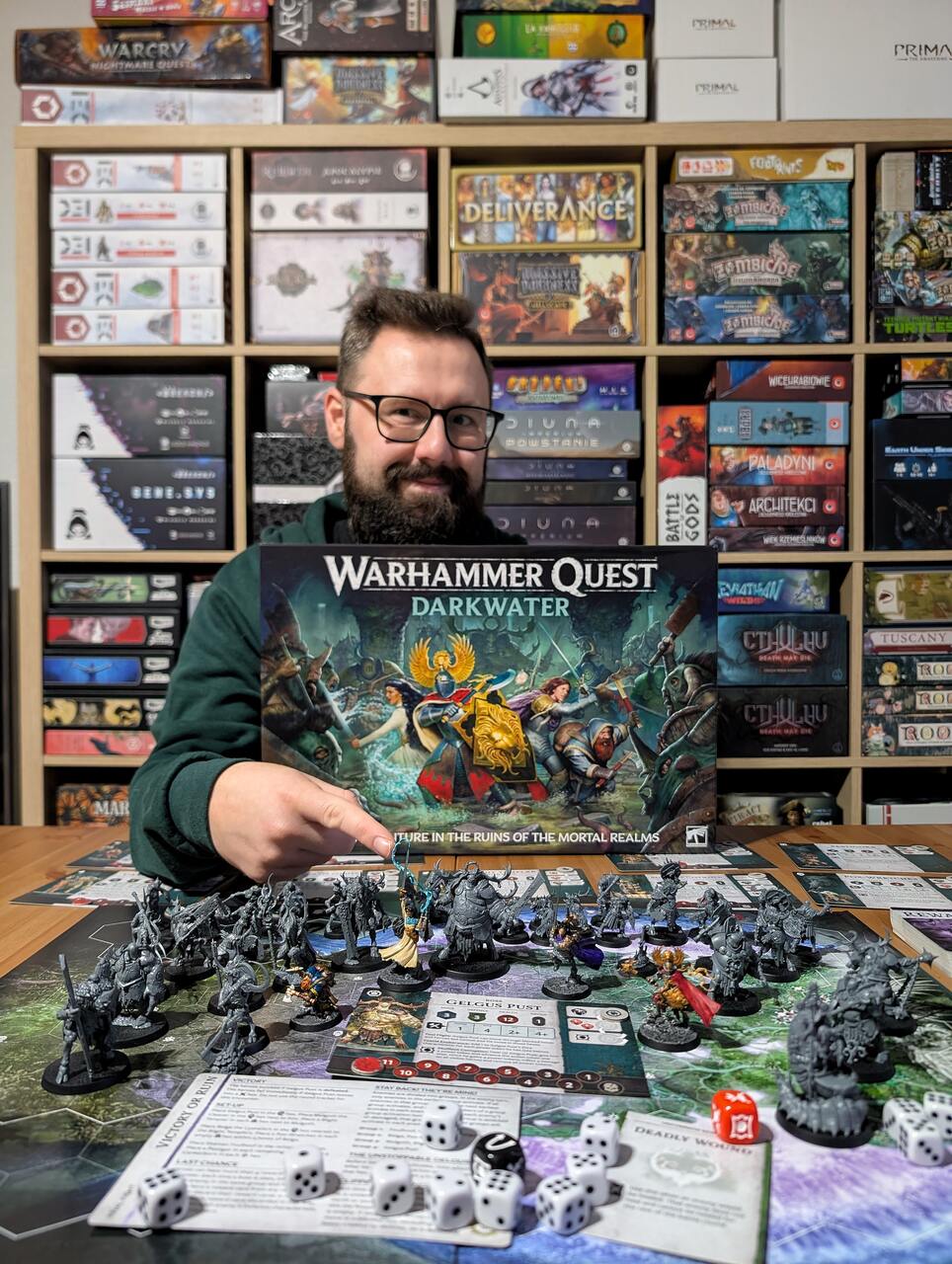
My wife and I spent three intense days playing through the three acts of Warhammer Quest, finally defeating the final boss. Was it time well spent?
You’ll find out in this “mini” review.
Storyline and missions
Warhammer Quest Dark Water is a cooperative dungeon crawler in which you fight against the servants of Nurgle.
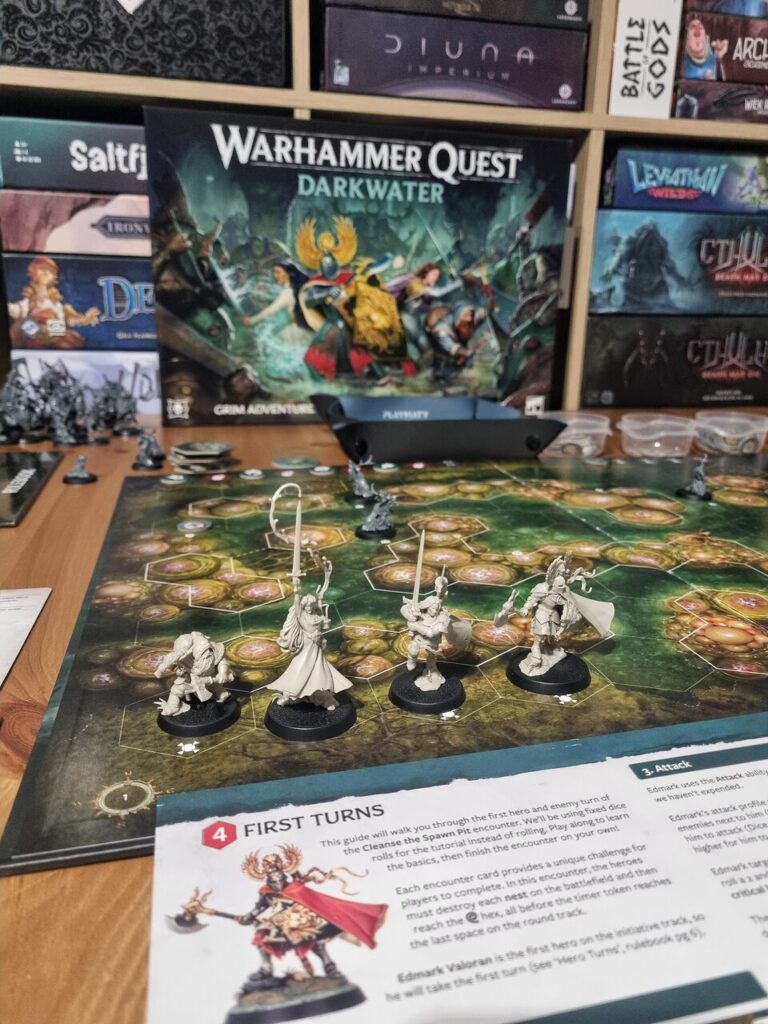
The game’s campaign is relatively short. There are 3 acts waiting for us, each divided into 7 events plus the final boss fight of that act.
When preparing an act, we draw 14 event cards. After completing each mission, we draw two cards from this pool and choose one of them to resolve.
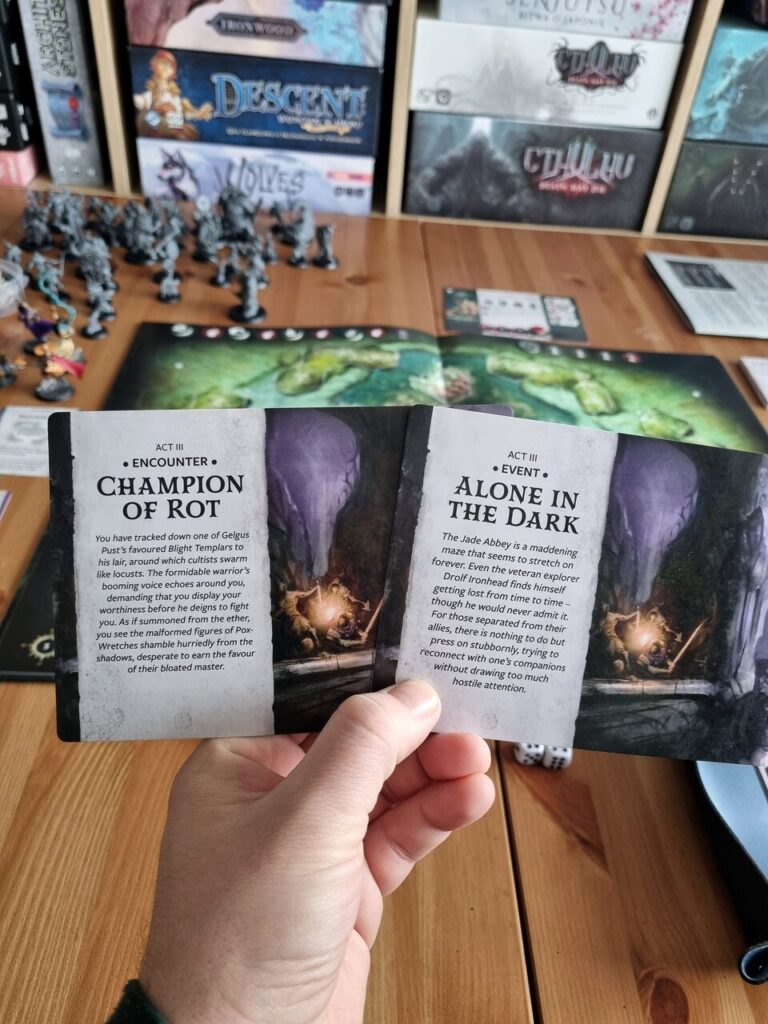
Events can be encounters or situations that we can resolve mainly with dice. We never know what will happen, and with a different approach, we may encounter completely different adventures.
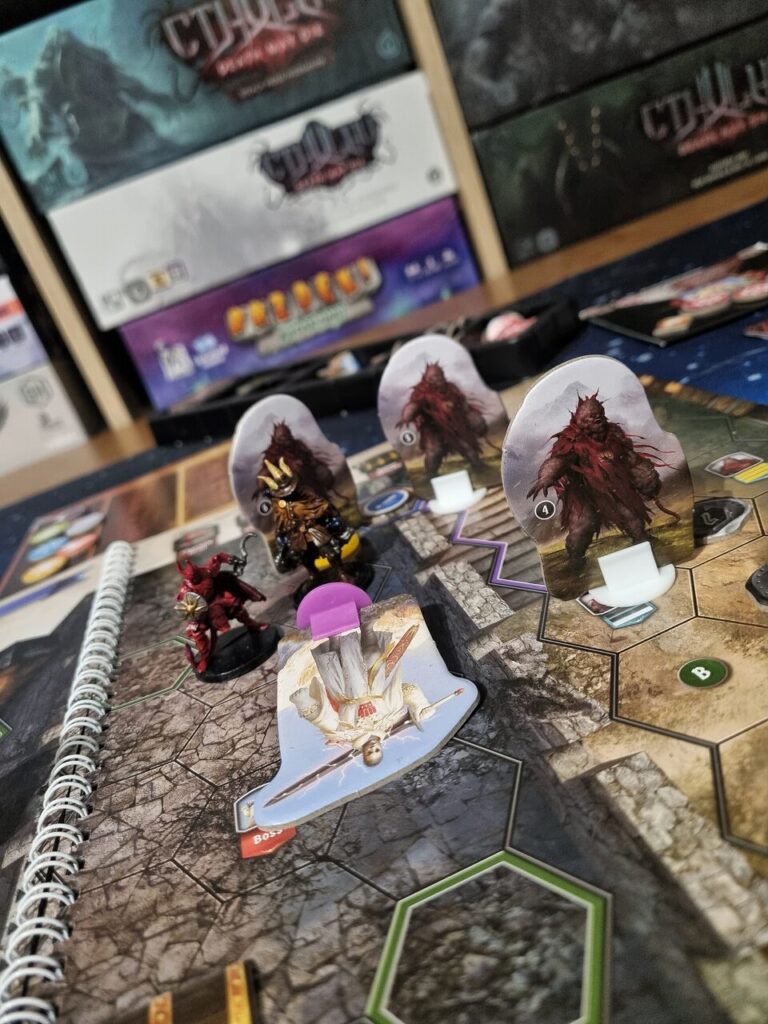
The battles will take us to an arena where we will face numerous hordes of Papa Nurgle. This is also where the biggest advantage of this game comes in. The scenarios are very diverse, and each of them brings something unique to our adventure. In one mission, we had to escort a water carrier on her way to the well. In another scenario, we sailed a boat through the swamps, repelling successive waves of enemies. There was also a mission in which we had to direct an energy pulse by positioning ourselves like relays so that it would reach its target.
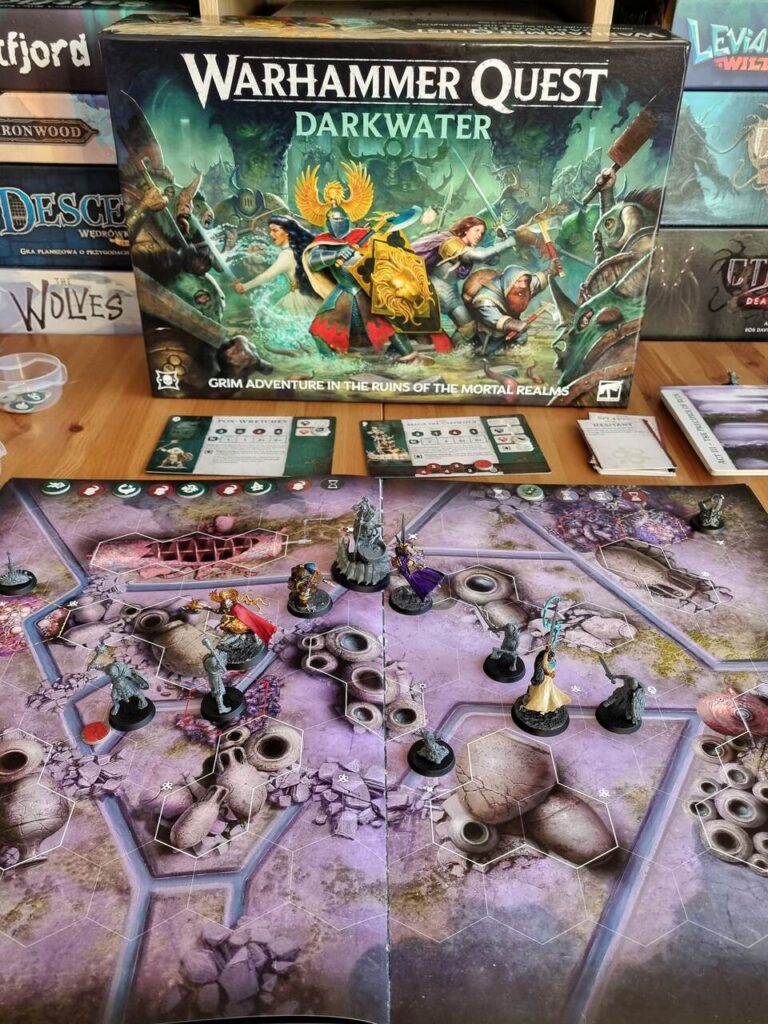
The same is true of the events we encounter. Although each of them greeted us with a wall of text and step-by-step instructions, they were a nice change of pace between the constant fighting. One in particular stuck in my memory, where we had to roll dice to get as close to the target as possible. It was like a simplified version of curling.
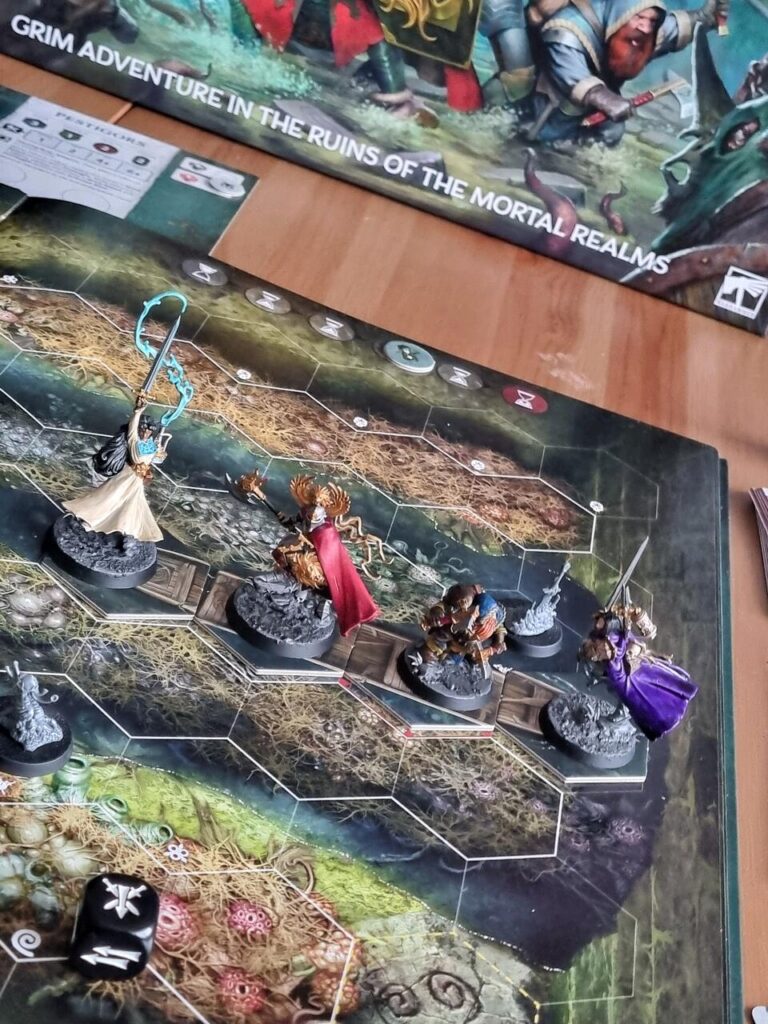
When it comes to the difficulty level of the scenarios, it is very unbalanced. Funnily enough, the initial missions were quite difficult. Enemies kept spawning, and we only had basic equipment at our disposal. On the other hand, the later missions seemed too easy. Only the bosses posed a real challenge. The battles with them were varied thanks to additional scenario rules, which made them very exciting.
Due to the fact that the structure of the Dark Water campaign is so loose, the game’s storyline suffered a bit. Most of the lore can be read in the manual, and the rest of the missions greet us with only a short introduction to what awaits us there. I missed the continuity that would tie the story together.
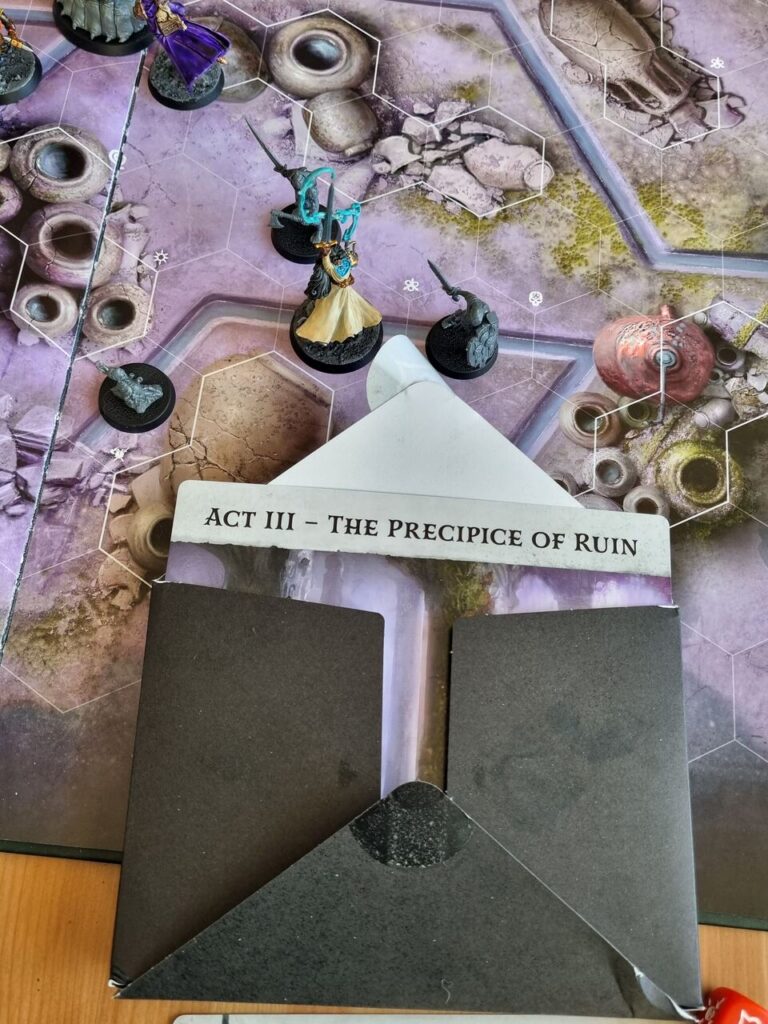
After completing each act, we will unlock new content for further gameplay. This aspect of legacy light is quite enjoyable. It’s just a shame that some of the new content can only be used in the next campaign. It’s as if the game forces us to play it several times.
Mechanically, only 3 actions, but differently
When activating a given hero, we will spend energy on movement, attack, and aid. To generate energy, you must exhaust the action card. This will make the action unavailable for the rest of the turn. Because of this, you have to plan everything carefully, taking into account what you will need.
It’s a bit of a Zombicide variation in the style of “you have 3 actions,” but with a slight twist. It wasn’t necessarily needed in this game, but overall it works well. Because we often had to choose whether we wanted to attack more often or move. We rarely used the aid action.
Dice pretzels
The combat is very dice-based and totally random. It’s kind of like playing Warhammer Underworlds, but unfortunately, we have almost no influence on the results of our rolls. There are few rerolls and other such possibilities. So we have to pray that it will work or not.
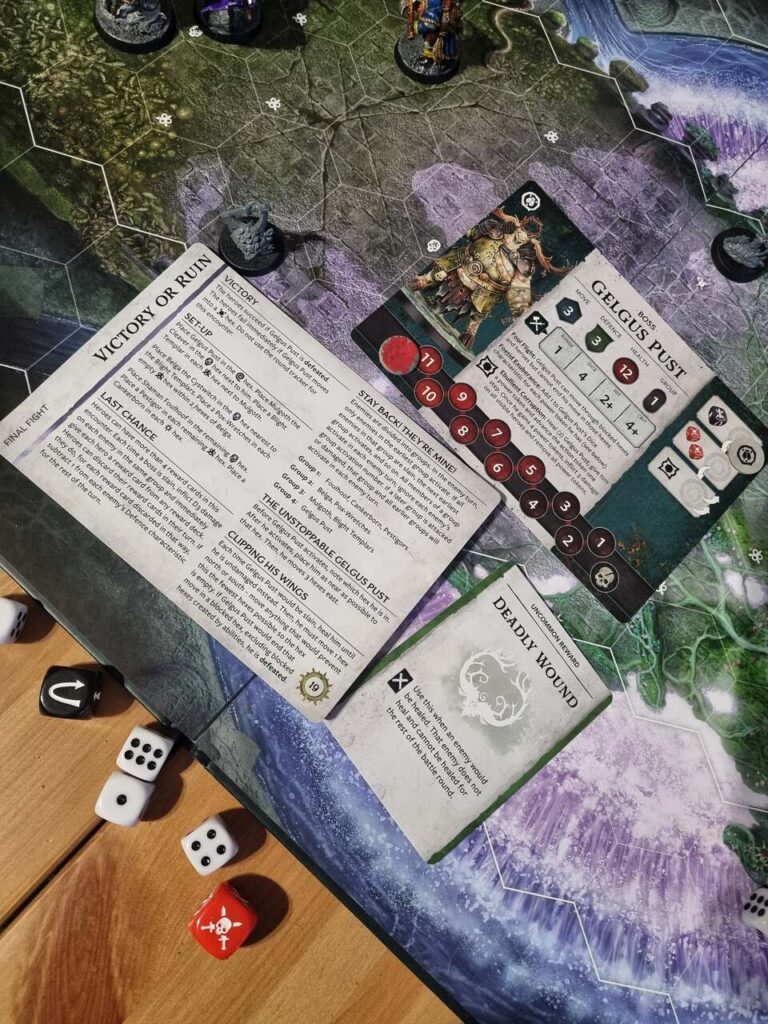
Unfortunately, it can be annoying when a hero activates and his next 3 attacks don’t hit the enemy. This is especially true when the opponent has high armor and we have to roll a hit and a critical to deal at least one wound.
Something that surprised me is that most heroes can travel a random number of hexes on the map. Movement is also random. However, we can spend extra energy to make sure we move up to 6 spaces or try to make 2 movement actions in a row. I haven’t seen anything like this in games of this type before.
To sum it up, it’s like Beer and Pretzels, but with a Warhammer flavor.
Necessary heroes
At the beginning of our campaign, we have 4 heroes available.
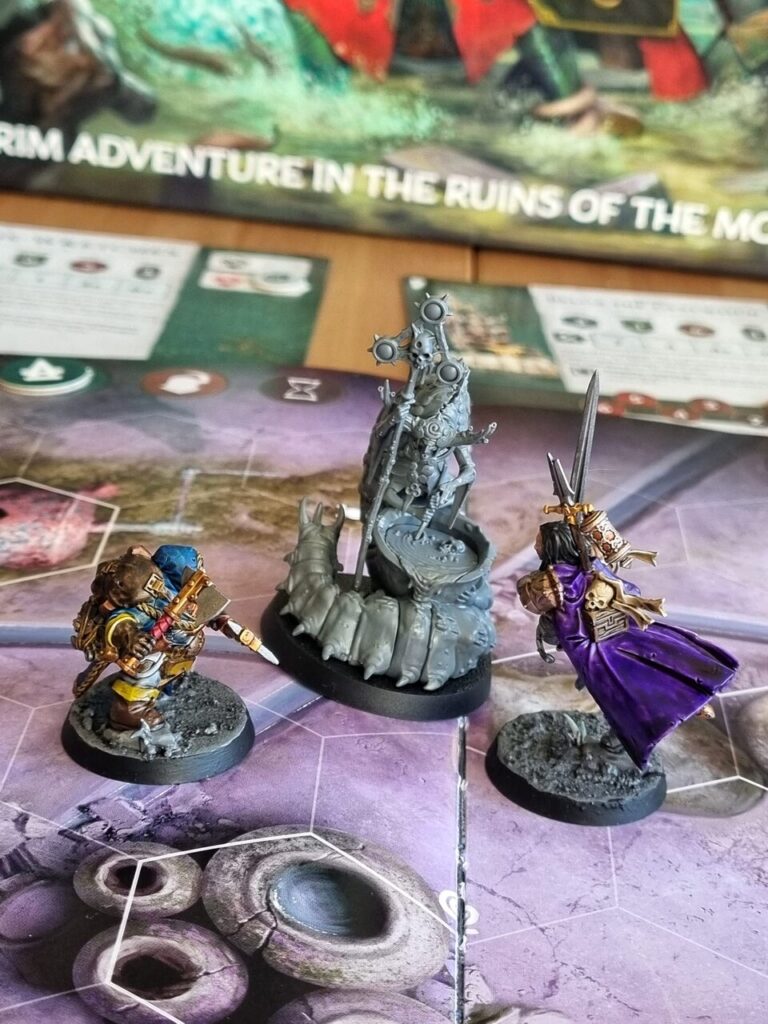
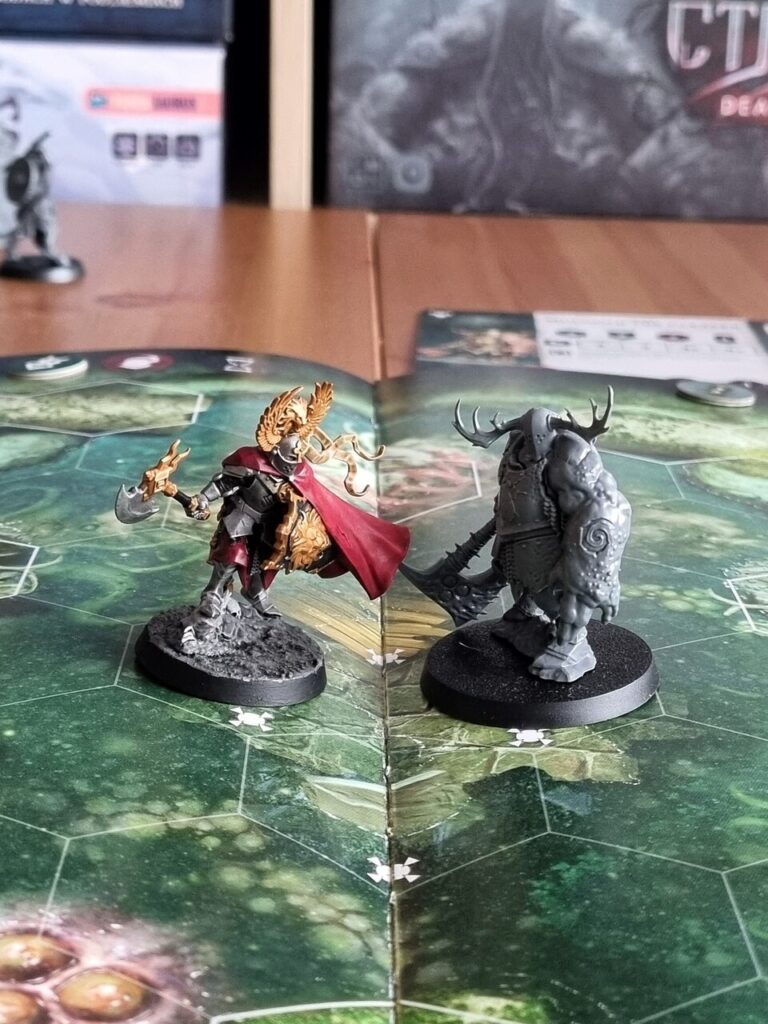
The Manticore Knight is a typical tank who can take enemy attacks head-on. I really like his ability to deal damage when he manages to defend against an opponent’s blow. Sometimes, just running into the ranks of Nurgle’s warriors was enough to get rid of them.
Next is Bren Tylis. In my opinion, she has the most useful ability. At the beginning of the round, she chooses what she wants to reroll. This is something that would definitely be useful for other characters.
The Dwarf is good at moving through enemies and various obstacles placed on the board. Other than that, he can’t do much else.
At the very end, we have the sorceress, who is probably the least useful heroine of the whole bunch. Her main advantage was placing a water token that blocked the path of enemies. I must admit that there were scenarios when it came in handy and practically guaranteed us an auto win. However, because she is so weak, we had to be careful not to let her get too close to our opponents.
Something like development
For me, the biggest downside of this game is the practically zero character development. Each character starts with one unique piece of equipment assigned to them. After completing missions, we will earn rewards, which can be a one-time ability, a passive skill, or something we can use once in a while. These rewards are received randomly, and we never know if we will get something useful. Especially since they vary in rarity, which modifies their power.
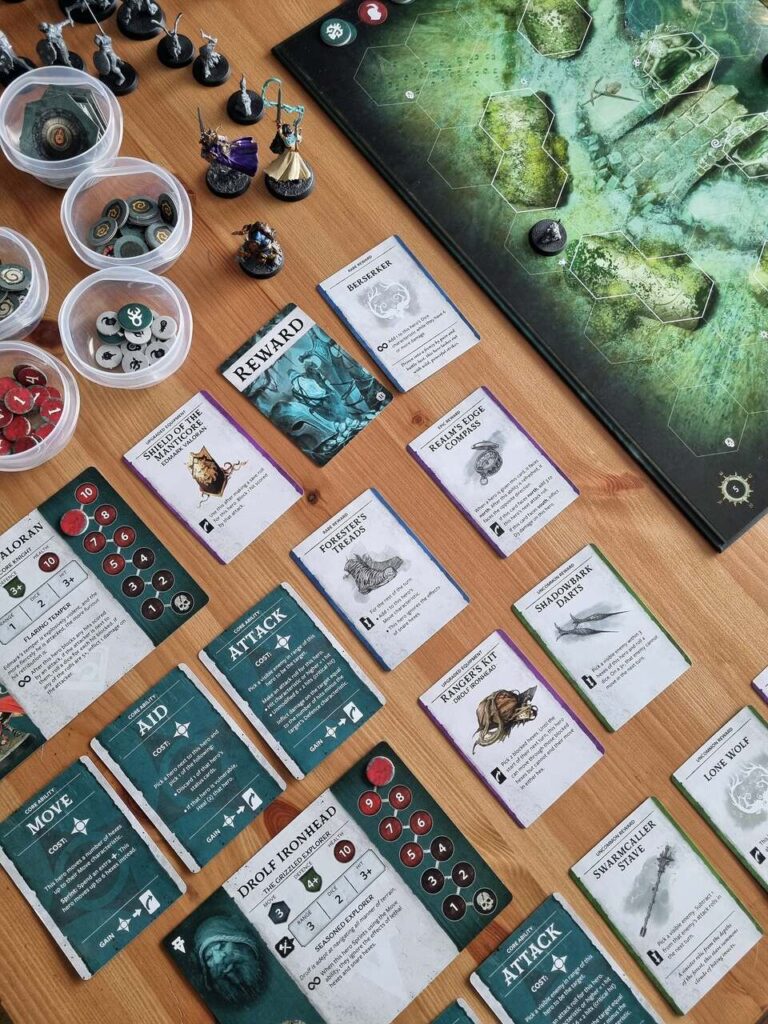
During the campaign, we do not develop the heroes’ stats and their initial abilities. We will finish with what we started with. Considering the mechanics of this game, there are some really cool things that could be done here. However, well…
During the campaign, we unlock new heroes and an alternative character card for the 4 initial heroes. However, I wasn’t able to check this out because I would have to go through it all again, and I’m not likely to do that anytime soon.
Papa’s minions
In terms of enemies, it’s pretty good. We have typical cannon fodder and we also have elite bosses who will cause us quite a few problems. The behavior of enemies will be dictated by dice rolls. The rules of the scenario will also influence what they can do on their turn. This will greatly diversify killing little Kelpi for the hundredth time.
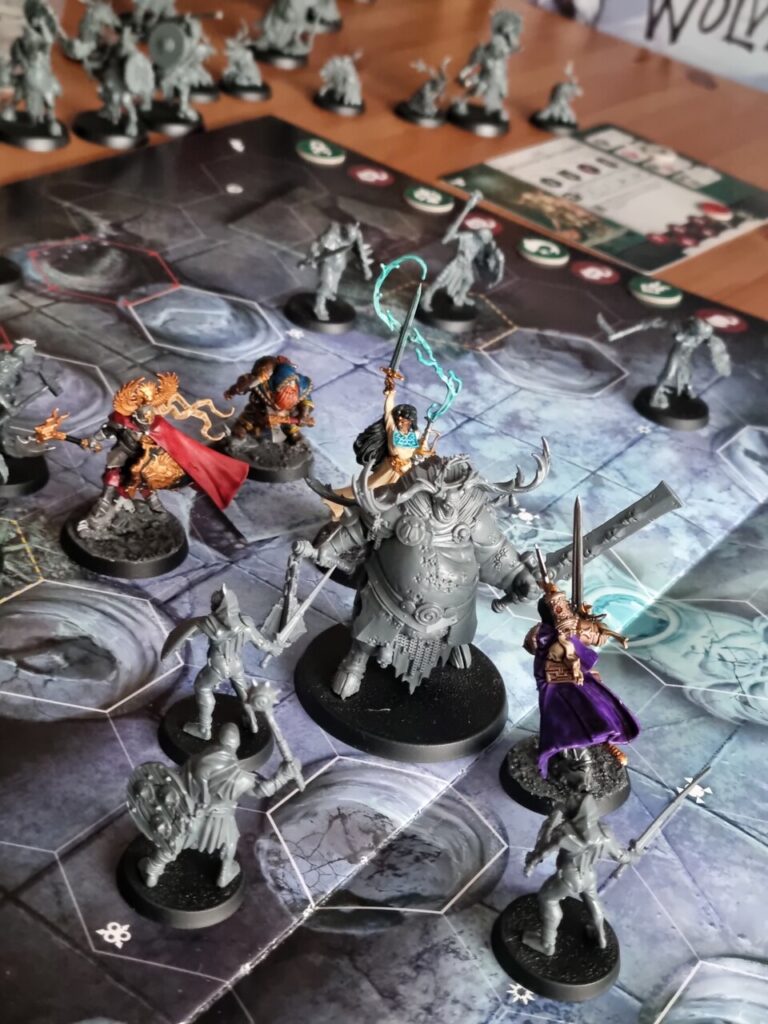
The bosses are challenging, and fighting them provided me with a ton of excitement. Each of them has their own mechanics and methods of operation. For me, they were a great culmination of each act.
Gameplay time and number of players
Each act of the campaign took us a few hours, and we completed the whole thing in 3 days of playing. The scenarios with combat took about 30-45 minutes. The events, on the other hand, were a quick interlude between successive battles. This is a nice change of pace, considering that sometimes campaign games dragged on and on.
Another advantage is that preparation for the game is very quick, thanks to the map book.
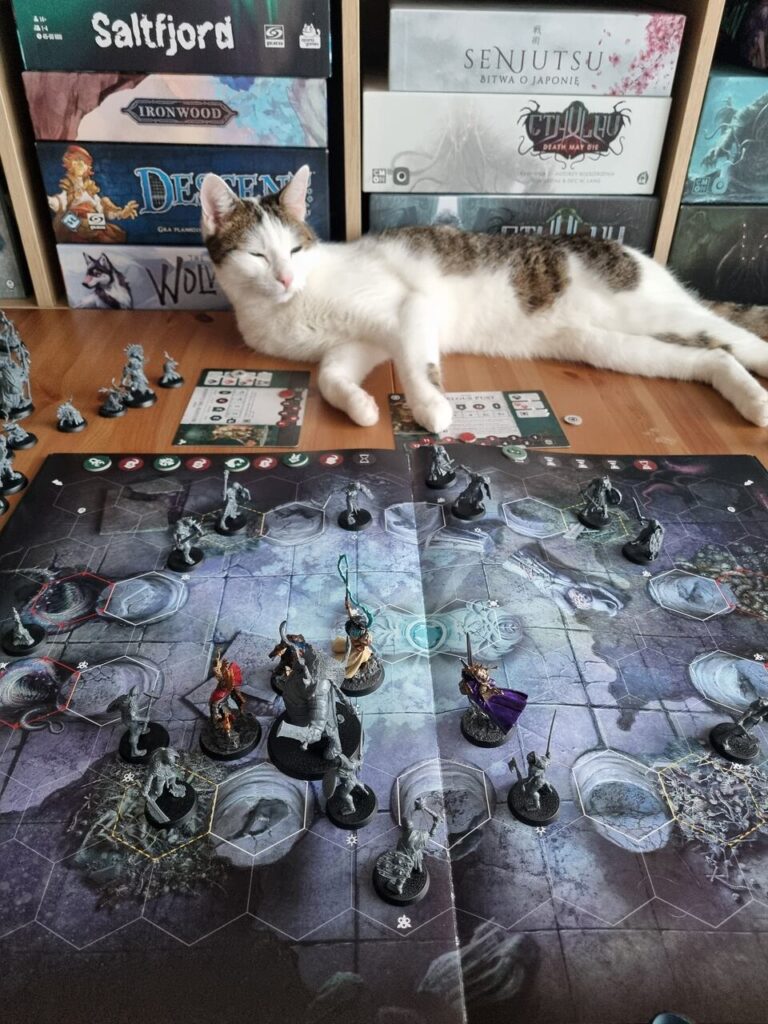
As for the number of players, you always have to play with four heroes, so each of us chose two characters. They are not difficult to control, so we had no problem with that.
Quality and components
As befits GW, the miniatures are simply out of this world. They are of the highest possible quality. The models beautifully reflect the art and convey a sense of decay. The same goes for the art available in Darkwater.
However, since I bought the game for so much money, I would expect at least some compartments for storing the models. Unfortunately, the game does not have an insert, and I had to find a way to deal with it. I am totally disappointed with this because I have to take everything out to get to the map book at the bottom of the box.
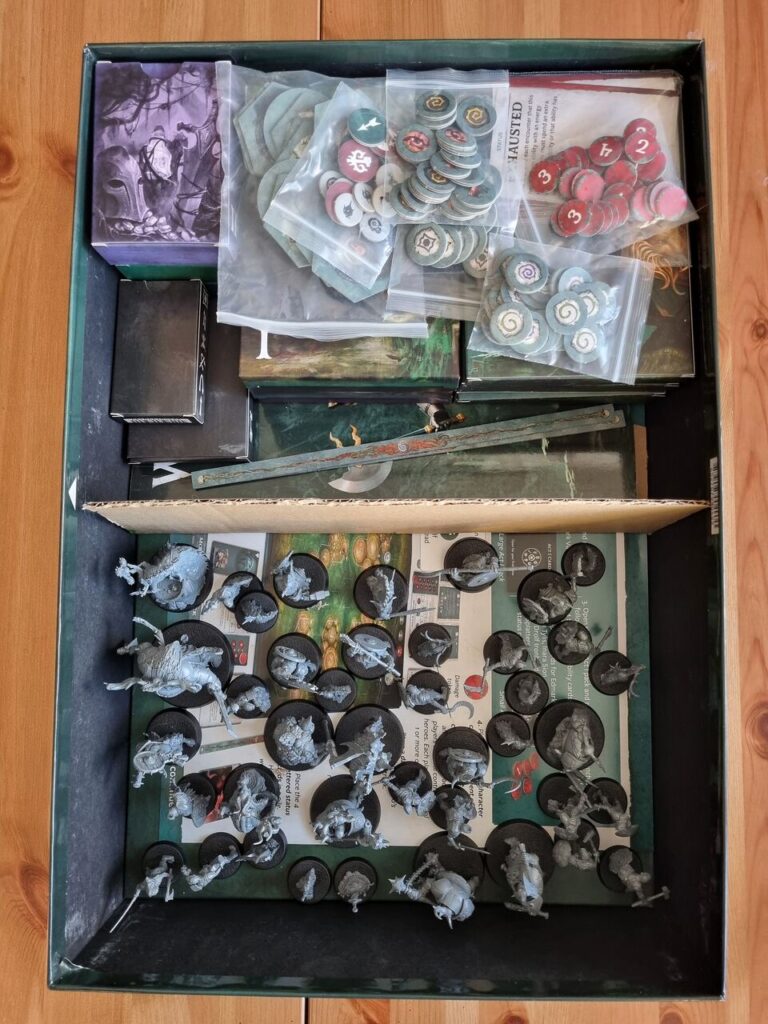
By the way, the map is a great solution that slightly softens the bitterness of not having an insert.
Summary
After completing the entire campaign, I can say that the game pleasantly surprised me with its diverse scenarios, loose campaign structure, and interesting boss fights. It is also clear that the developers have improved the gameplay compared to the previous Cursed City.
However, there were a few missteps. Especially considering the virtually zero character development, shallow storyline, and a fairly large dose of randomness, which in most cases we had no control over.
However, overall, we had a good time playing. We sat down to this title fully aware of what we were dealing with. Because Warhammer Quest Dark Water is a typical representative of the beer, pretzels, dungeon crawler genre, and for now, it will be nothing more.
Therefore, if you are considering purchasing it, you are better off going for Massive Darkness 2. Because that game does everything the same, only 1000 times better.
Final verdict: It could have been worse, but this is Warhammer.
Pros
- Warhammer atmosphere
- Varied scenarios
- Interesting boss fights
- Mini-games
- Cool campaign structure
- Quick setup
- Awesome miniatures
- Map book
Cons
- Price
- No insert
- High randomness
- Virtually no character development
- Shallow storyline