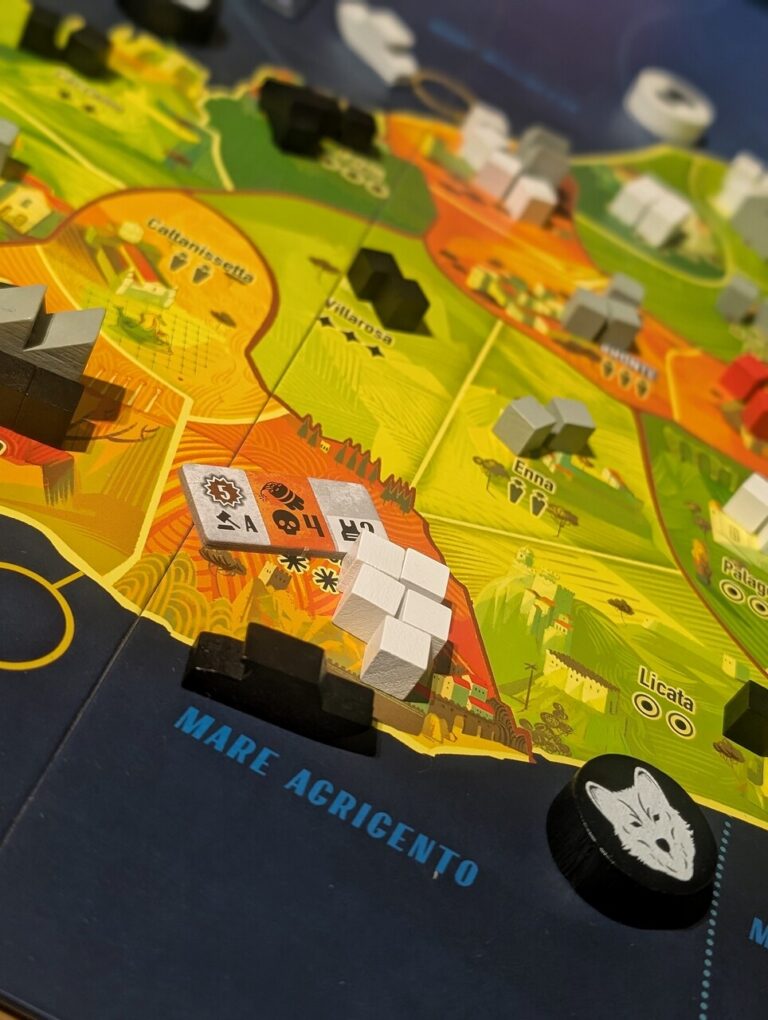
Clans of Caledonia Industria
Which classics games are worth revisiting?
For me, one such classic is Clans of Caledonia. Over the last few years, I’ve had the chance to play this Euro game several times. The funniest thing is that I used to think this game was very difficult. It was my early days with modern games and I felt like Andy from Parks and Recreation: “and at this point I was too afraid to ask”. However, I played courageously.
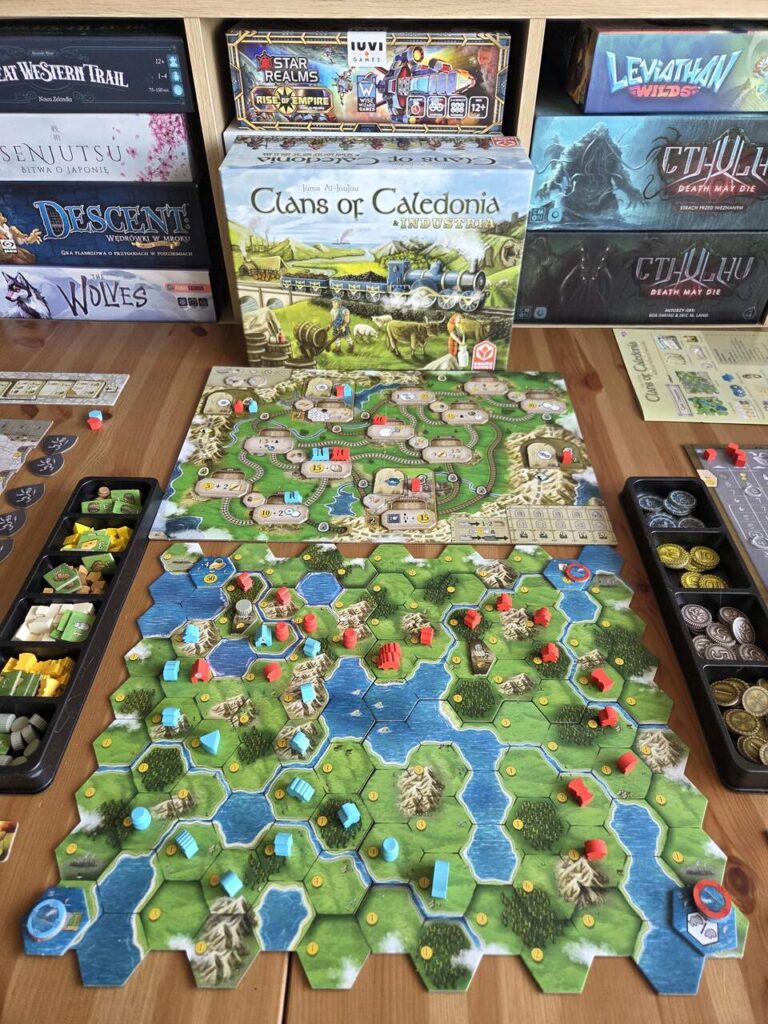
Last year marked a renaissance of Clans of Caledonia for me. We started playing quite regularly on Board Game Arena, and it was one of those Euro games that worked well online. My perspective on the game itself has changed significantly, given the titles I play now. That’s why I invite you to read this review, which has been maturing in my mind like a fine whisky.
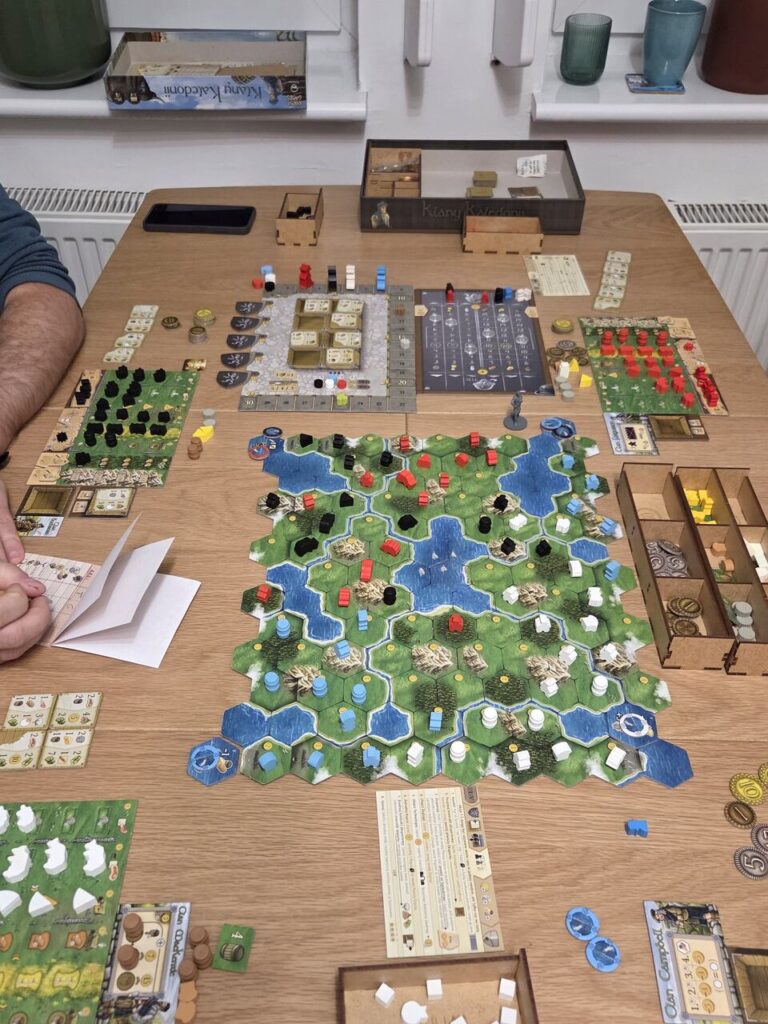
In Clans of Caledonia, each of us will lead a Scottish clan tasked with producing the goods needed to fulfil contracts. To do this, we’ll construct new buildings, create production chains and manage goods on the shared market. It may not be as complex a game as Settlers, but watching our business grow is hugely satisfying. Especially when we feel the cash flowing into the pockets of our kilt.
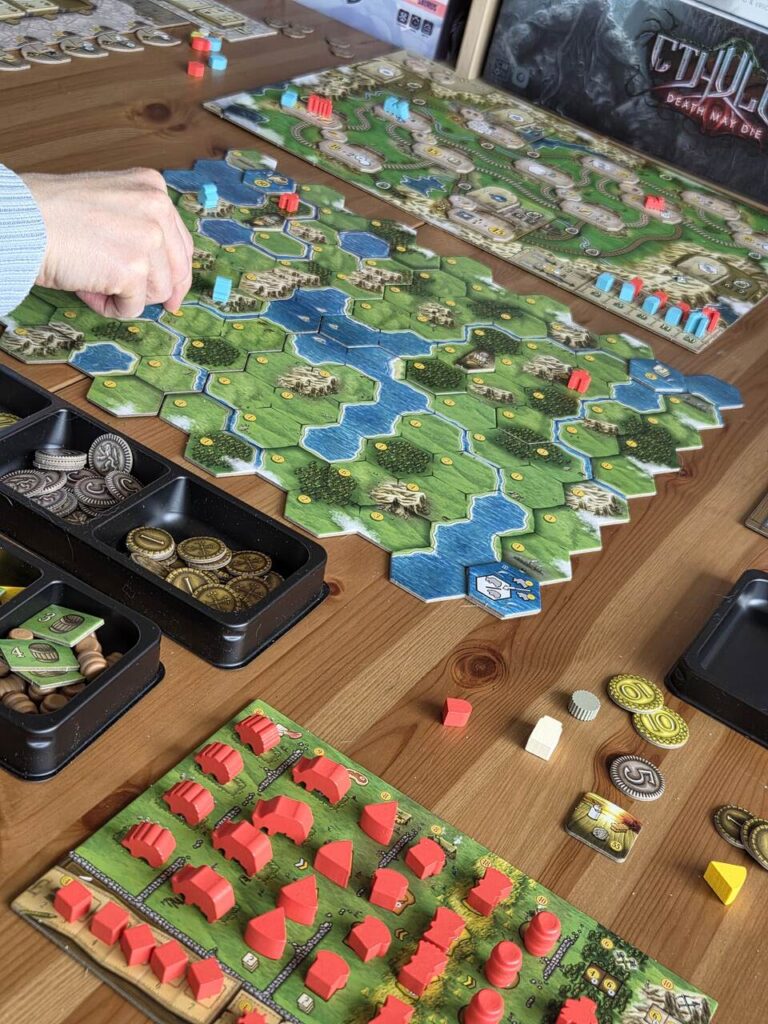
A key aspect of the game is fulfilling trade contracts, which provide us with various bonuses and victory points. An interesting twist is that we earn more points for the product that all players have brought to the market the least. In line with the principle that what is exclusive is worth more. At first, it was difficult for us to understand all these relationships, but subsequent games proved to me that observing my friends’ moves is essential to achieving the best possible result.
The contracts themselves also strongly guide us as to which businesses we should invest in. This is particularly true of those in the first round. However, later on, new contracts may not fit our business model. In that case, we can help ourselves by purchasing raw materials from the market. Our actions will influence product prices in accordance with the law of supply and demand. This is another economic aspect of the game designed to simulate real life.
I also really like the asymmetrical clans we’ll be leading. Each one focuses on a different aspect of the game. This allows us to use different strategies and approaches. However, you need to master their abilities well to fully exploit their potential.
Some clans might seem a bit ‘unbalanced’. Surely someone must have tested them, right? Especially given the ‘milk’ clan, whose strategy never expires. As is often the case in asymmetrical games, there are better and worse Scottish clans. That’s why it’s worth leaving the weaker ones in the box and letting them gather dust like barrels of whisky. Alternatively, we can pull them out when playing with newbies to even out their chances of winning.
Another plus of Clans is that players’ turns are very quick. Each of us performs just one action, and then it’s the next Scot’s turn. As a rule, the first two rounds of Clans are a warm-up, and only later might a slight decision paralysis set in. All because you have to count every pound so that you can afford all your actions.
When I first ventured into these Scottish hills, I was surprised to find that there are even elements of area control here. As we set up new businesses, we’ll expand across the map, trying to cover as much territory as possible. Other players will try to hinder us by blocking our paths. Sometimes they’ll even do it on purpose, because we also get points at the end of the game for building chains of units. The last time we played, my wife maliciously took the spot where I wanted to build my last cheese factory. That really threw a wrinkle into my plans. Because of her, I’ve developed a real intolerance for that kind of actions.
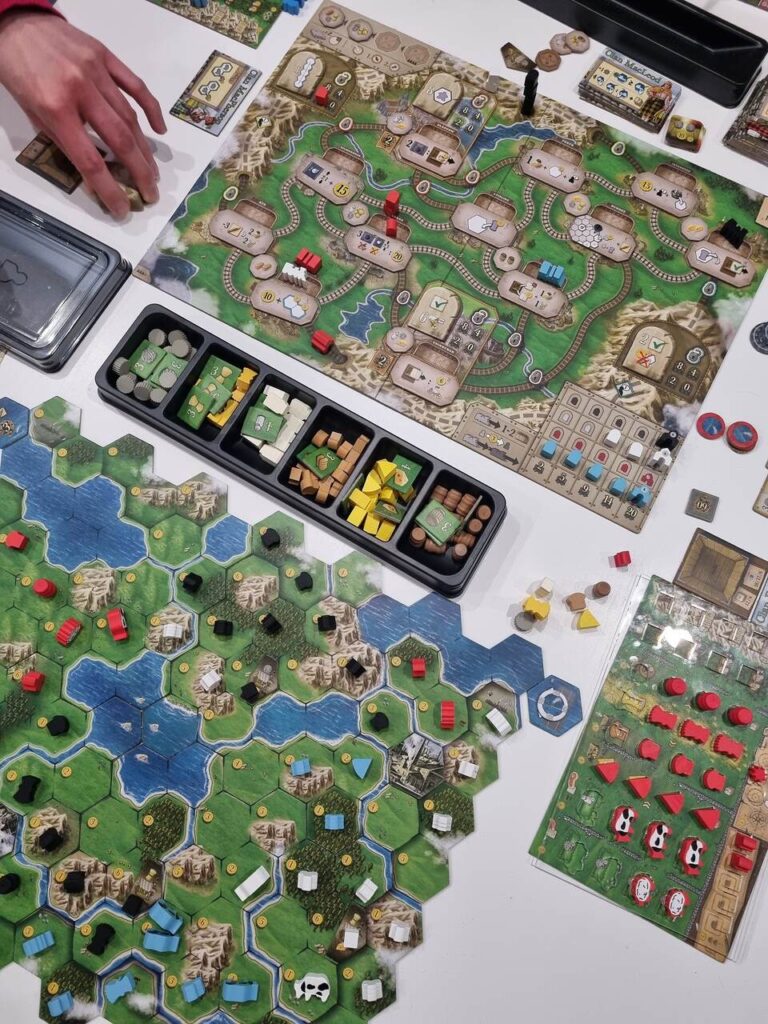
Another nice feature is that if we build next to another player’s factory, we can buy goods from the market at a discount. So even though it’s a Euro game, there’s still some interaction between players here.
Number of players and playing time
As I mentioned earlier regarding interaction between players, there’s certainly more of it when we play in a larger group. There’ll also be a greater impact on market prices for goods.
With just two players, the map becomes a bit smaller, limiting the area we can settle. However, it doesn’t matter how many people I play with, as everything runs just as smoothly.
I could stop my review here, but it’s racing on like a high-speed Pendolino.
INDUSTRIA
Industria is an expansion for Clans of Caledonia that introduces several modules and variants which can be added to the base game.
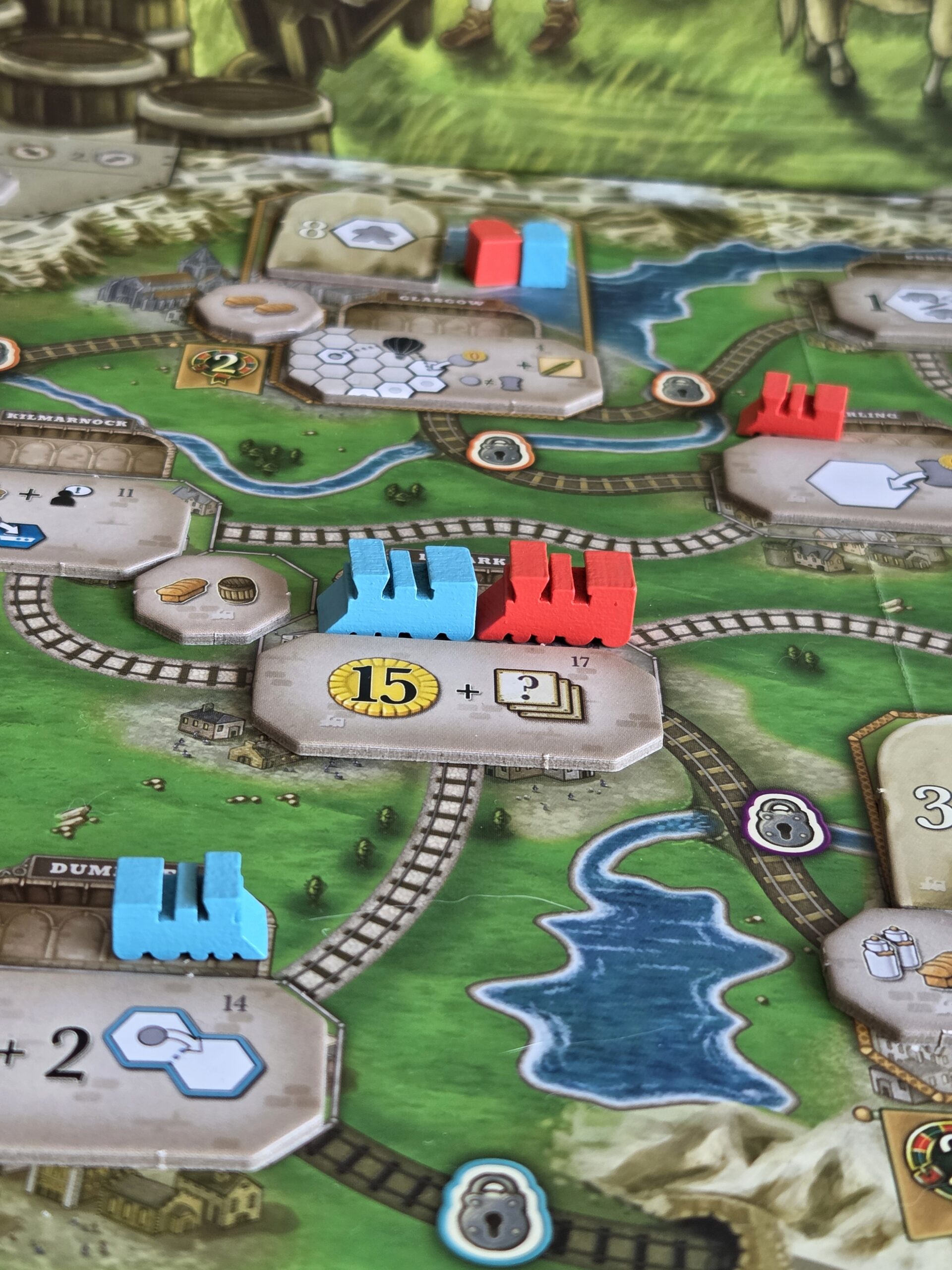
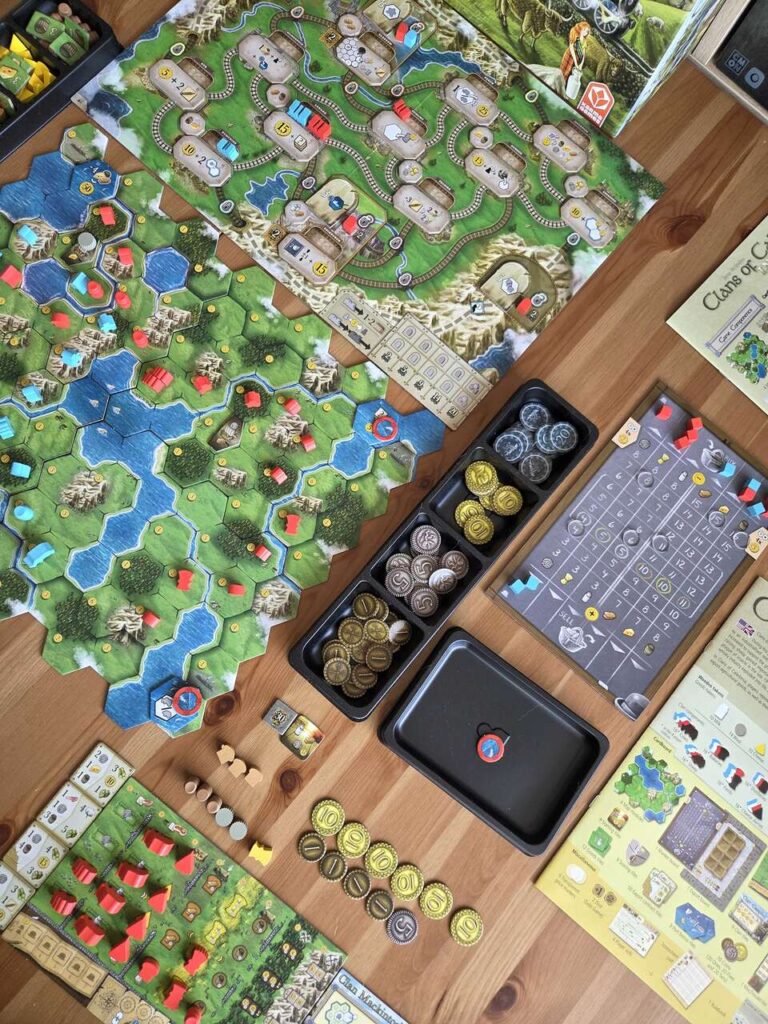
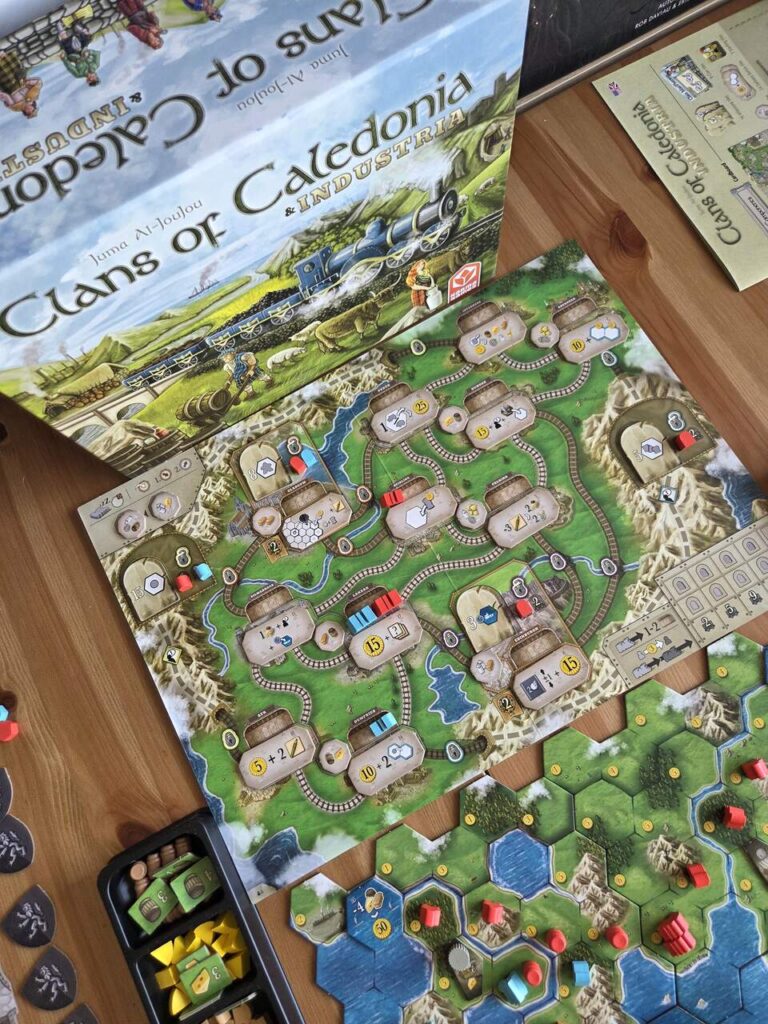
The most extensive module is the railway. Thanks to trains, we can transport goods across Scottish towns, which earns us points and powerful bonus actions. I see this module as an expanded version of the ports, offering an interesting alternative to fulfilling contracts. It’s just a shame that we can only make one delivery per round. Because of this, our train won’t be very busy and we won’t get much use out of this module. As a huge fan of euro games, I love anything that races along the tracks, so I’ll gladly add this expansion to my regular games. Since I’ve got it anyway, why not?
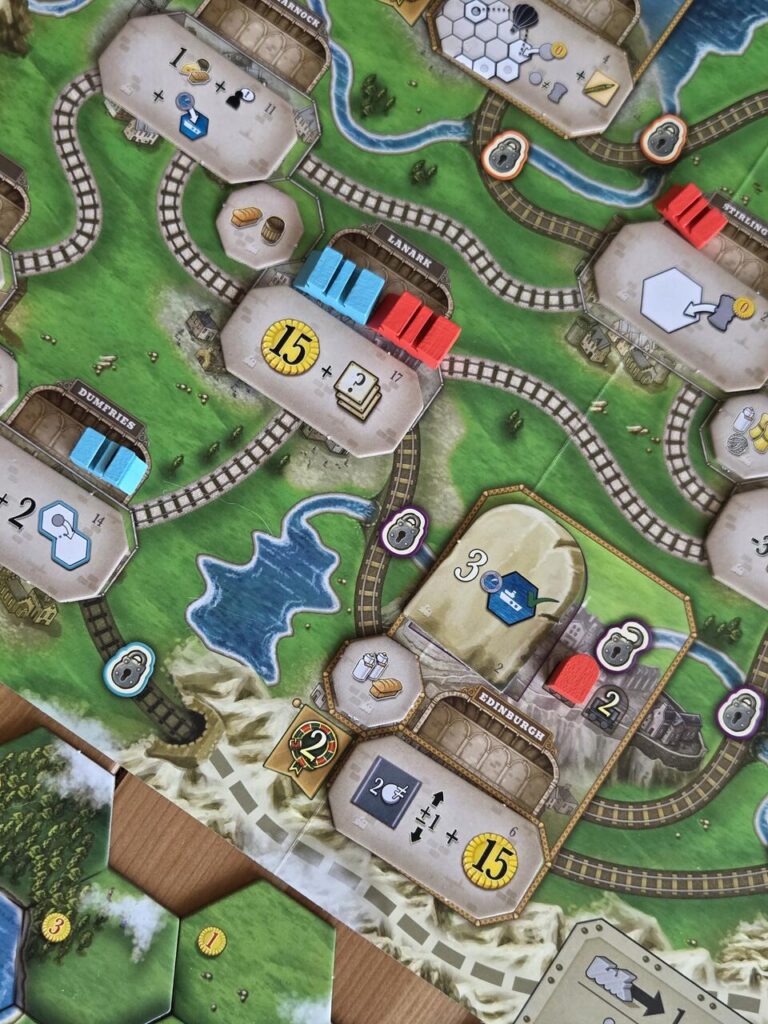
Another module worth playing with is the contract board. It tells us which contracts will be available in the next round. It allows us to prepare better, as we’ll know which goods are worth stockpiling.
To add some variety to the gameplay, we can also include a bonus scoring module at the end of the game. This adds a bit of variety to the final scoring. Just like the trains, it allows us to take different paths while playing.
In my opinion, the least useful module is the farmers’ market supposedly the most romantic spot for couples in American TV series. They block spaces on the board, but let us sell goods at better prices. It’s by no means a must-have.
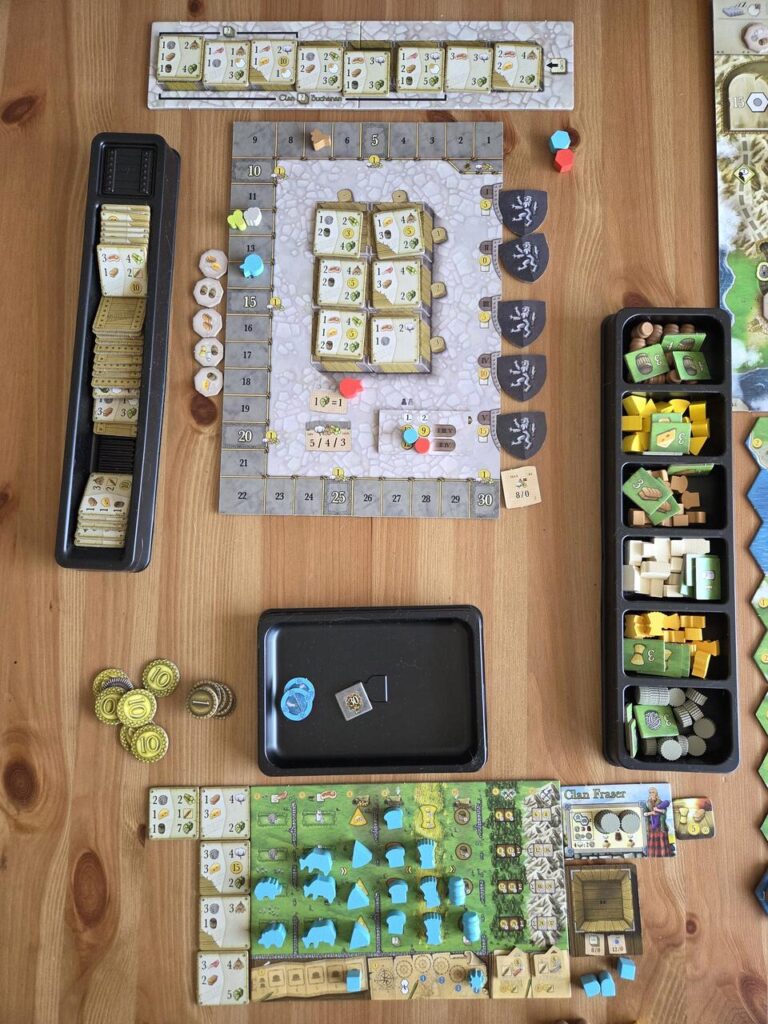
The best thing about Industria are the new clans. Each one has an interesting and unique ability. Most importantly, these skills are useful and more balanced than in the base game. There is a marked improvement here in terms of clan asymmetry. My favourite is the Mackintosh Clan. Thanks to the constant cash flow I received from strategically placing my units, I was able to do more in a round.
I’ve saved quality and components for last. This is another aspect of the expansion that offers a decent upgrade. The Clan big box organises all the game components, keeping the box tidy. It’s simply brilliant. It’s just a shame that the player boards don’t have slots for our units. If they had I will moooo from the excitement.
Summary
If I were to rate the basic Clans of Caledonia, I’d say it’s a solid Euro game. The rules are simple, the turns are quick, and expanding our business is just as satisfying as in the classic Settlers. On top of that, we get clans with asymmetrical abilities, allowing us to adopt different strategies for fulfilling contracts.
The Industria expansion simply expands on all these options from the base game, providing us with greater variety. We get new Scottish clans, new scoring opportunities, and numerous modules and variants that add variety to the scenery and gameplay. All the game components fit into a fantastic insert, which has definitely increased my enthusiasm for this game.
Final verdict: Clans of Caledonia is a classic that I will always be happy to return to.
Pros
- Infrastructure development like in Settlers
- Asymmetrical Clans
- Fast turns
- Solid gameplay
- Sensational Big Box
- Numerous new modules to modify gameplay
Cons
- Unused potential of trains
- Player boards still flat
[Game provided by Karma Games]